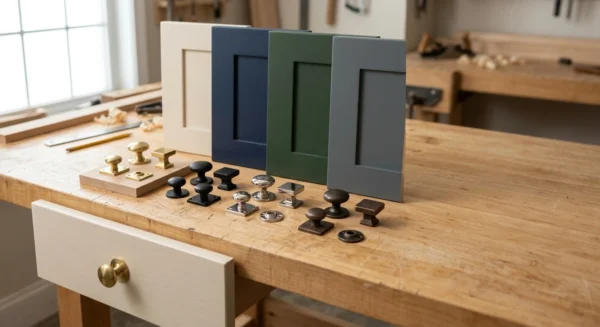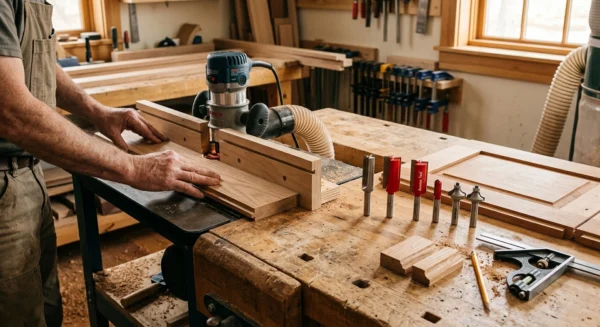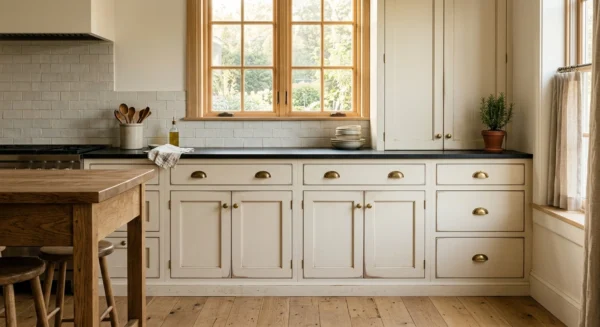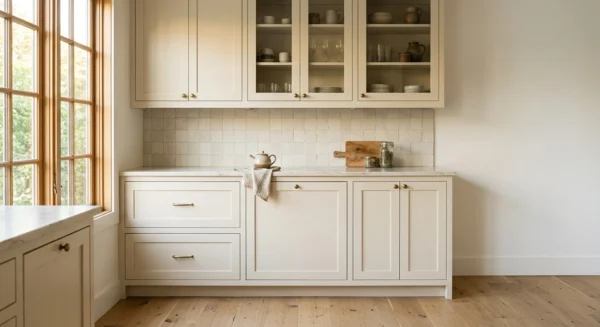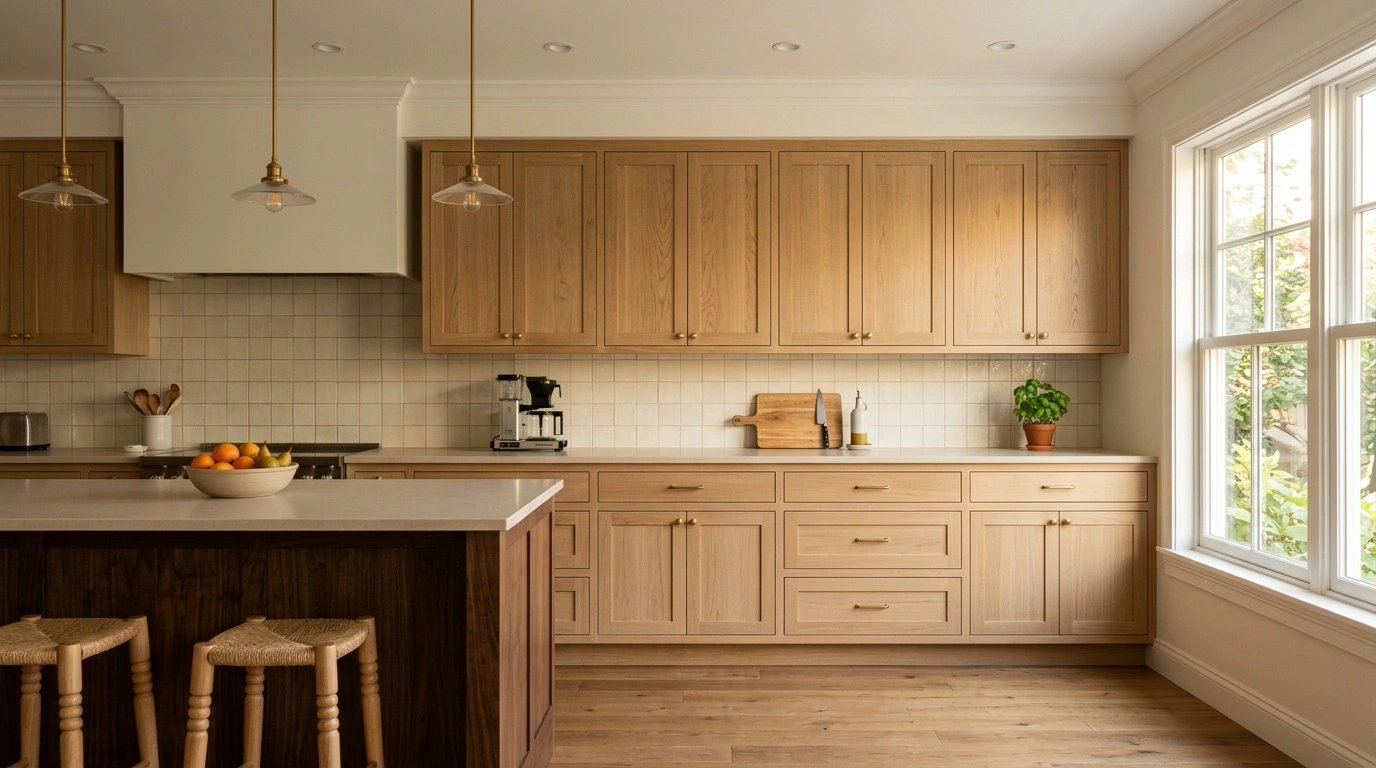
Wood Cabinets offer visible grain, repairable surfaces, and doors that can serve a kitchen for decades. However, the best specification rarely uses solid lumber throughout. Hardwood doors and face frames pair well with cabinet-grade plywood boxes, which stay flatter and hold fasteners reliably. Oak, maple, cherry, walnut, and hickory each differ in grain, color, hardness, and price.
Clear or lightly stained finishes highlight natural variation and add warmth that printed laminates cannot fully reproduce. Still, wood can dent, darken, fade, and move as indoor humidity changes. Species, construction, and finish matter as much as appearance. For most homes, hardwood earns its cost on doors, exposed panels, and trim, while plywood works better for cabinet boxes.
Are Wood Cabinets Worth the Cost?
They are worth considering if you value natural grain or plan to keep the kitchen for many years. Hardwood doors also allow touch-ups and refinishing instead of immediate replacement. They make less sense for very tight budgets, recurring water leaks, or spaces with uncontrolled humidity.
Material alone does not guarantee quality. Thin drawer bottoms, weak joints, poor finishes, and low-grade hinges can undermine an expensive hardwood selection. Ask the cabinet company to list door materials, center panels, boxes, backs, drawers, hardware, and finishes separately.
A quote labeled “maple cabinetry” can describe several different products. It might include maple doors on particleboard boxes, maple veneer over plywood, or a broader hardwood-and-plywood build. An itemized specification prevents costly misunderstandings.
| Option | Installed cost | Typical timeline | Disruption | Practical lifespan | How much must change |
|---|---|---|---|---|---|
| Stock cabinets with hardwood or wood-veneer fronts | About $175–$400 per linear foot | Often several weeks after final measurements, depending on availability | Full cabinet removal and installation | Commonly 15–25 years with sound boxes, hardware, and installation | Most existing cabinets, counters, and related trim |
| Semi-custom hardwood cabinetry | About $350–$800 per linear foot | Often 6–12 weeks, with longer waits for specialty finishes | Full removal and installation | Often 20–30 years or longer with repairable doors and replaceable hardware | Most existing cabinetry, although appliance and plumbing locations may remain |
| Custom hardwood fronts with plywood boxes | About $700–$1,500 or more per linear foot | Commonly 10–20 weeks from approved drawings to installation | Full removal, fitting, scribing, and installation | Several decades with proper construction, finishing, and maintenance | The design can preserve or change the existing layout |
| Hardwood refacing on sound existing boxes | About $250–$600 per linear foot | Usually faster than replacement, although custom doors require fabrication time | Doors and drawer fronts come off, while boxes remain | Depends heavily on the condition and remaining life of the boxes | Doors, exposed surfaces, hinges, and pulls change, but the layout remains |
| Painted MDF-front cabinets | Often comparable to lower-cost stock hardwood or below semi-custom cabinetry | Similar to stock or semi-custom ordering schedules | Full removal and installation | Long-lasting in dry rooms, but swollen edges are difficult to repair invisibly | Most or all existing cabinetry |
These figures provide 2026 planning ranges for professional installation in a mid-cost U.S. metropolitan market. They are not national averages or firm bids. The ranges usually exclude countertops, appliances, plumbing changes, electrical work, flooring, and structural alterations.
Species, door style, decorative panels, organizers, delivery access, and local labor rates can shift the total. Inset construction costs more because installers must maintain narrow, consistent reveals around every front. Finished ends, appliance panels, drawer stacks, and pull-outs also raise the price.
Linear-foot pricing helps with early comparisons, but it cannot capture every design difference. Compare itemized quotes, material specifications, and elevations before choosing a supplier. The lowest linear-foot price may omit important components.
What “Wood Cabinets” Actually Means
Few modern cabinet systems should use solid lumber throughout. Solid boards expand and contract across the grain as humidity changes. Wide solid sides and large flat doors can cup, crack, or bind.
Cabinet-grade plywood cross-laminates thin veneers to improve dimensional stability. It also provides dependable screw-holding strength when manufacturers use suitable cores and face veneers. Builders commonly use plywood for cabinet sides, bottoms, shelves, and backs.
Hardwood works best where its grain, edges, or joinery remain visible. Common locations include face frames, door frames, drawer fronts, moldings, and trim. Manufacturers may use veneered plywood or MDF for wide center panels because these materials stay flatter than solid boards.
A traditional five-piece door contains two vertical stiles, two horizontal rails, and a captured center panel. On a solid-wood door, the panel must float within its grooves. Gluing the full perimeter can split the panel or pull apart the frame joints.
Some manufacturers place small rubber space balls inside the grooves to center the panel while allowing movement. Flat-panel Shaker doors often use plywood or veneered MDF centers. Raised-panel doors may use profiled hardwood or an engineered center.
Wide slab doors need particular care because solid boards can warp. A veneered plywood or MDF core often provides better stability. Engineered components do not automatically indicate poor quality; their grade, location, edge treatment, and finish determine their value.
Choosing a Wood Species
Maple
Hard maple has fine grain and a light cream color. It suits contemporary, transitional, and restrained Shaker kitchens. Its hardness handles busy kitchens, although sharp impacts can still leave dents.
Clear finishes preserve maple’s brightness, while pale brown stains add warmth. Dark wiping stains may highlight blotches or uneven absorption. A sprayed toner or professionally controlled finish usually creates more consistent dark color.
Maple pairs well with white quartz, lightly veined stone, brushed nickel hardware, and slightly darker floors. Light and age gradually change its color. Doors hidden from daylight may eventually differ from exposed doors.
Red Oak and White Oak
Oak has open pores and prominent grain. Choose it when you want the material to look unmistakably natural. The grain also helps disguise minor scratches and everyday wear.
Red oak often shows pink or reddish undertones. White oak usually appears browner, more neutral, or slightly olive, depending on its cut and finish. Quarter-sawn white oak displays straighter grain and visible ray fleck, but careful cutting and sorting increase its price.
White oak works well with warm white counters, cream tile, muted sage, brass, and matte black hardware. Natural, cerused, and low-sheen finishes give it a quieter appearance. Heavy orange stains and ornate profiles can make the design feel tied to an earlier remodeling period.
Cherry
Cherry starts pinkish or reddish brown and darkens with age and light exposure. This shift reflects the material’s natural character rather than a finish defect. Items left on a counter can cause nearby areas to age at different rates.
Cherry has smooth grain and takes clear finishes well. However, it is softer than hard maple and shows dents more readily. Simple inset, raised-panel, or flat-panel designs let the color carry the design.
Cream quartz, soapstone, warm gray tile, and aged brass complement cherry’s deepening tone. Very dark stains hide much of its characteristic color change. They can also make an expensive species look generic.
Walnut and Hickory
Walnut brings deep brown color, flowing grain, and occasional pale streaks. It works well on islands, slab drawer fronts, and carefully matched feature walls. Walnut costs more than many domestic species and is not exceptionally hard, so choose it primarily for appearance.
Hickory creates a much stronger contrast between pale sapwood and dark heartwood. It is hard and durable, but its busy grain can overwhelm a small room. Patterned counters and floors may compete with it.
Pair walnut or hickory with quiet stone, simple tile, and restrained hardware. Always review a full-size door in the chosen finish. A small sample chip cannot show the species’ full range of grain and color.
Finish Determines Durability
Factory-applied conversion varnishes, catalyzed coatings, and sprayed waterborne systems usually produce consistent results. Ask for written information about resistance to water, cleaners, heat, and abrasion. The manufacturer’s care instructions should identify safe cleaning products.
A low-sheen finish hides fingerprints and fine scratches better than high gloss. Clear coatings reveal natural color changes, while toners and glazes reduce visible variation. Heavily layered color treatments can make future spot repairs more difficult.
Film finishes often wear first around knobs, sink doors, and trash pull-outs. A qualified finisher can often clean, scuff-sand, and recoat a hardwood surface. Some veneers also allow refinishing, but aggressive sanding can cut through the thin face layer.
Oil finishes create a close-to-the-grain appearance and allow easy renewal. However, they usually resist standing water and kitchen chemicals less effectively than robust film coatings. They also require careful handling during application and disposal.
Rags containing linseed, tung, or Danish oil can self-heat as the oil cures. Spread them flat outdoors to dry away from buildings and combustible materials. Alternatively, submerge them in water inside a sealed metal container before following local disposal rules.
Solvent-based coatings require strong ventilation and an appropriate organic vapor cartridge respirator. An N95 or ordinary dust mask does not protect against solvent fumes. Spraying adds inhalation and overspray risks, so a properly equipped finishing area provides the safest setting.
Factory finishing often justifies its cost in an occupied home. A controlled shop manages dust, airflow, application, and curing more reliably than most job sites. It also keeps strong odors and airborne finish away from living areas.
How Wood Cabinets Stand Up to Daily Use
Hardwood and plywood tolerate normal kitchen use well, but neither material is waterproof. Sink bases, dishwasher edges, trash pull-outs, coffee stations, and range-side doors usually show damage first. Wipe up standing water and repair plumbing leaks promptly.
Follow the dishwasher manufacturer’s side and top clearance requirements. Poor clearance can direct hot steam onto a door edge after every cycle. A durable coating slows moisture absorption, but it cannot protect surfaces that remain wet.
Keep indoor humidity reasonably steady throughout the year. Large seasonal swings cause doors to expand, contract, and sometimes rub. Concealed-hinge adjustments can often correct minor movement without planing or replacing a door.
Clean finished surfaces with a soft microfiber cloth, water, and a small amount of mild dish soap. Follow with a dry cloth. Do not soak joints, panel edges, hinge cups, or unfinished surfaces.
Avoid abrasive powders, scouring pads, oven cleaner, acetone, and strong alkaline degreasers. These products can scratch, soften, cloud, or strip the finish. Spray cleaners onto the cloth instead of directly into seams.
Silicone furniture polishes can interfere with later touch-ups and refinishing. Wax may trap grime inside detailed profiles. Inspect sink cabinets, worn edges, loose pulls, failed caulk, and door alignment at least once a year.
Where Engineered and Non-Wood Materials Perform Better
Paint-grade MDF often makes the better door when you want a smooth, uniform painted finish. It machines cleanly, stays flat, and does not show wood grain through paint. However, MDF is heavy and can swell permanently when water reaches an unsealed edge.
Particleboard is not plywood. It provides an economical, stable panel, but it generally has weaker edge screw holding and lower water tolerance. Product density, fastener type, and edge protection influence its performance.
High-pressure laminate offers easy cleaning and strong wear resistance. It can suit utility rooms, accessible kitchens, and hardworking contemporary spaces. Damaged laminate edges, however, rarely allow invisible repairs.
Thermofoil creates a smooth, painted appearance at a lower price. Heat from ovens, toasters, and other appliances can loosen the film or damage the adhesive. Check required appliance clearances before using thermofoil near heat sources.
Painted cabinetry can calm a room with patterned floors, counters, or backsplashes. Warm white, greige, sage, and navy also provide more consistent color than natural hardwood. Chips may expose a contrasting substrate, especially under dark paint.
Some sheen levels show greasy fingerprints more readily. White coatings may yellow because of smoke, grease, limited daylight, or certain finish chemistries. Modern waterborne cabinet coatings reduce ambering compared with many traditional oil-based products.
Waterborne and latex coatings still need adequate curing time. Some products require up to 30 days to reach full hardness. Treat doors gently and avoid aggressive cleaning during that period.
Refacing, Refinishing, or Replacing
Refacing works when the boxes remain square, dry, secure, and properly arranged. Installers can add new doors, drawer fronts, veneer, finished ends, hinges, and pulls. This approach changes the appearance with less demolition than full replacement.
Refacing cannot correct narrow drawers, wasted corners, swollen particleboard, poor appliance clearances, or blocked traffic. It also preserves the existing cabinet dimensions. Inspect every box before investing in new exterior materials.
Refinishing costs less in materials but requires careful preparation. The work includes cleaning, labeling, repairs, sanding, dust control, application, and curing. Color matching becomes difficult when sunlight and age have changed the original finish.
Choose replacement when leaks have swollen the boxes or shelves sag badly. New cabinets also make sense when appliance sizes or structural layout changes require different dimensions. Hire a professional when veneer is thin, color matching matters, or the project requires indoor spraying.
Test painted cabinets for lead before sanding or stripping them in a home built before 1978. Sanding, scraping, or heating lead paint can spread hazardous dust through nearby rooms. Paid contractors must follow the EPA Renovation, Repair and Painting rule when it applies.
For non-lead sanding, use dust extraction, ventilation, and a properly fitted N95 respirator. Chemical stripping requires ventilation, eye protection, chemical-resistant gloves, and the cartridge specified by the product manufacturer. Consumer paint strippers cannot contain methylene chloride under current federal restrictions.
Planning a Wood Cabinet Order
Request a full-size sample door in the exact species, cut, stain, and sheen. View it vertically in the kitchen during daylight and after dark. Warm LEDs, cool tile, and reflective counters can change how the color reads.
Confirm the materials used on exposed ends. Manufacturers may use matching hardwood, veneer, printed skins, or separate furniture panels. Ask how they handle sapwood, knots, mineral streaks, color variation, and grain matching.
Order the recommended touch-up materials with the cabinetry. Matching an aged stain several years later can prove difficult. Store the products according to their labels and note any shelf-life limits.
Approve detailed elevations before production starts. The drawings should show fillers, moldings, finished ends, appliance panels, and hardware locations. Check every door and drawer for clearance.
Standard base cabinets measure 34.5 inches high and 24 inches deep. A countertop usually brings the finished height to about 36 inches. Wall cabinets commonly measure 12 to 13 inches deep and come in 30-, 36-, and 42-inch heights.
Manufacturers often offer widths in 3-inch increments from 9 to 48 inches. The usual space between the counter and upper cabinets measures 18 inches. A typical toe kick is about 4.5 inches high and 3 inches deep.
Check doors against adjacent walls, refrigerator handles, range handles, and projecting countertop edges. Fillers and finished panels increase cost, but they prevent binding and complete the cabinet run. Resolve layout conflicts before spending more on walnut, cherry, or quarter-sawn oak.
A Durable Specification That Preserves Natural Warmth
For a long-lived kitchen, specify cabinet-grade plywood boxes and well-made hardwood or veneered fronts. Add sturdy drawer boxes, replaceable hardware, and a finish intended for kitchen use. Review each component rather than relying on a broad material label.
Place the visual budget where people can see it. Prioritize doors, drawer fronts, exposed ends, moldings, and the island. Use stable sheet goods inside the cases, where solid lumber adds movement without improving appearance.
Choose maple for quiet grain, oak for texture, cherry for deepening color, walnut for a refined feature, or hickory for contrast. Control leaks, wipe spills, use gentle cleaners, and adjust rubbing doors promptly. Properly specified wood cabinets can age, accept repairs, and remain useful instead of requiring early replacement.